

Jump to a Policy Topic
Policy Issues
NBWA educates local and federal officials and regulators on the value of state-based alcohol regulation as well as the economic and regulatory issues that impact America’s beer distributors, who are local family-owned businesses that service every state and congressional district throughout the United States.
-
State-Based Alcohol Regulation: Delivering Safety and Promoting Growth
The Issue: America’s state-based alcohol regulatory system, established by the 21st Amendment, has created the world’s safest and most vibrant alcohol marketplace. This structure carefully balances control and access through a licensed and secure alcohol sales system.
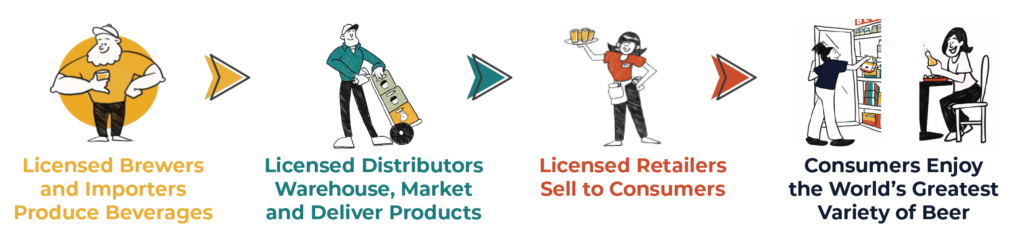
More than 3,000 independent beer distributors play an essential role in this system. They work closely with state and municipal governments to collect taxes, combat underage drinking and support efforts to ensure that local laws are being followed.
Why It Matters: Legislators make decisions that can bolster or undermine this system. One policy that would undermine effective regulation is allowing alcohol to be shipped through the U.S. Postal Service. Shipping alcohol through the mail preempts state law, removes licensing requirements and is harmful to our nation’s successful state-based alcohol regulatory structure, which provides:
Public Safety- Chain of custody enables product integrity
- Local authority enables communities to decide how alcohol is sold and regulated
Competition
- Suppliers of all sizes — including small, local brewers — have access to the market
- The result: 9,000 breweries and unparalleled consumer choice
Growth
- Efficient collection of more than $65 billion in annual tax revenue
- Over 135,000 well-paying distributor jobs
We Encourage Congress to:
Maintain our nation’s successful state-based alcohol regulatory system and reject any legislative efforts to allow shipping alcohol through the mail
Join the 21st Amendment Caucus
House Members can support a system of effective, state-based alcohol regulation. Contact:
• Rep. Bice: Robert.Sar@mail.house.gov, 202-225-2132
• Rep. Lee: Aneil.Gill@mail.house.gov, 202-225-3252 -
Tariffs and Trade
The Issue: The $400 billion American beer industry will be impacted by changes to national trade policy, including tariffs and other levies placed on imported goods.
Why It Matters: America’s 3,000 independent beer distributors supplement their robust portfolio of domestic products with beer and beverages from across the globe. Additionally, the beer industry uses a significant amount of aluminum and steel in products ranging from cans and packaging to warehouse and delivery equipment. It is important for lawmakers and the administration to consider the vital role that beer and beverage distributors play in local economies and the impact tariffs may have on this critical industry.
We Encourage Congress To:
Support pro-growth trade policies that benefit both consumers and local economies.
-
Differences Between Alcohol Products
The Issue: In 2020, Congress reinforced the longstanding principle that beer, wine and liquor should be taxed differently. These lines of distinction follow consensus public health and policy principles regarding alcohol. Some liquor manufacturers are now attempting to blur the lines by:
- Proposing a lower tax rate for liquor-based beverages sold in a can.
- Seeking to expand the substitution drawback of excise taxes paid on imported alcohol.
We Encourage Congress To:
Maintain federal alcohol tax policy that reflects the differences between alcohol beverage products.
Oppose the Duty Drawback Clarification Act, which has been introduced in previous Congresses.
It would allow certain liquor producers to further lower their effective tax rate by expanding the substitution drawback program on imports. -
Federal Cannabis Policy
The Issue: As Congress and the administration continue their work on cannabis policy, including hemp-derived Delta-9 products, policymakers should draw on the expertise and experience of the alcohol industry and public health.
Why It Matters: States are considering how to appropriately regulate THC and CBD products. The lack of clarity in federal policy on these products creates significant workplace challenges for businesses and hurts their ability to make informed business development decisions
We Encourage Congress To:
Draw on the expertise and experience of the alcohol industry while considering federal policies that maintain the integrity of the existing alcohol regulatory structure, providing clarity to businesses and protecting consumers.
-
Workforce and Commercial Driver’s License
The Issue: Beer and beverage distributors provide competitive wages, meaningful benefits and long-term career opportunities. However, they face significant labor shortages, particularly for CDL drivers.
Why It Matters: Over 3,000 independent beer distribution facilities employ more than 135,000 hardworking Americans. These businesses play a critical role in supporting local economies and ongoing labor challenges ripple through the supply chain, from the smallest towns to the largest cities.
We Encourage Congress to:
Take steps to address the nationwide labor and CDL shortages that create challenges to the supply chain.
Provide support for CDL training including apprenticeships, trade school and community college initiatives.
-
Multiemployer Pension Plans
Multiemployer Pension Plans
The Issue: The long-term stability of multiemployer-defined benefit pension plans is uncertain. Recent proposals from the Pension Benefit Guaranty Corporation could increase withdrawal liability
Why It Matters: Beer distributors who participate in these pension plans are committed to meeting their contribution responsibilities. While some of the most troubled plans have been temporarily stabilized after receiving Special Financial Assistance, further action is needed to ensure long-term stability
We Encourage Congress To:
Address withdrawal and partial withdrawal liability, including requirements that could harm small businesses.
-
Revitalizing Local Businesses
The Issue: Bars, restaurants and entertainment venues impacted by the pandemic continue to face challenges with lower foot traffic and higher operating costs.
Why It Matters: Energy-efficient draft beer systems provide operational savings while encouraging on-premise spending. Providing tax incentives for draft systems will help bolster the hospitality industry that employs over 16 million Americans.
We Encourage Congress to:
- Support the Creating Hospitality Economic Enhancement for Restaurants and Servers (CHEERS) Act when it is reintroduced. This legislation would provide a tax deduction for bars, restaurants and entertainment venues with energy-efficient draft beer systems.