

Blog
“Is It Worth It?”: Understanding Return on Effort in Beverage Distribution
NBWA Associate Member Volume X Profit Technologies (VXP) discusses in their Associate Member Viewpoint how understanding and applying Return on Effort (ROE) can transform sales execution, incentive design and team engagement across the beverage distribution industry.
By Bud Dunn, President
Volume X Profit Technologies (VXP)
In the beverage distribution world, we love data. From scan reports to depletion allowances to margin performance by SKU, numbers drive our decisions. But there’s one key metric you won’t find in your route accounting system — and yet, it affects execution more than most KPIs: Return on Effort (ROE).
At its core, ROE asks a simple question: Was the outcome worth the energy I had to spend?
It’s not a formal financial ratio. It’s a gut-check calculation reps make daily. And whether we realize it or not, this unspoken equation shapes how salespeople respond to incentives, allocate time, and ultimately decide what gets executed in the market — and what doesn’t.
Why Reps Opt Out (Even When the Dollars Are There)
One example of ROE: A rep was asked why he didn’t push a new supplier draft brand. His answer?
“Why would I sub out a handle that’s already selling better, has higher velocity, and drives more gross profit for one you’re forcing me to focus on just because it’s new? That’s not worth it.”
That’s ROE in action. No formal training needed. The rep had calculated that swapping a high-performing brand for a new one wasn’t a good return on his effort — or his commission.
This disconnect happens more often than we think. A $25 payout might seem fair for a large display, but when that display takes three trips, two phone calls, a case stack, and relationship capital with a buyer, reps may walk away thinking, “Not worth it.”
Even worse, they may just go silent. Most reps know when you’re wasting their time. They just stop telling you.
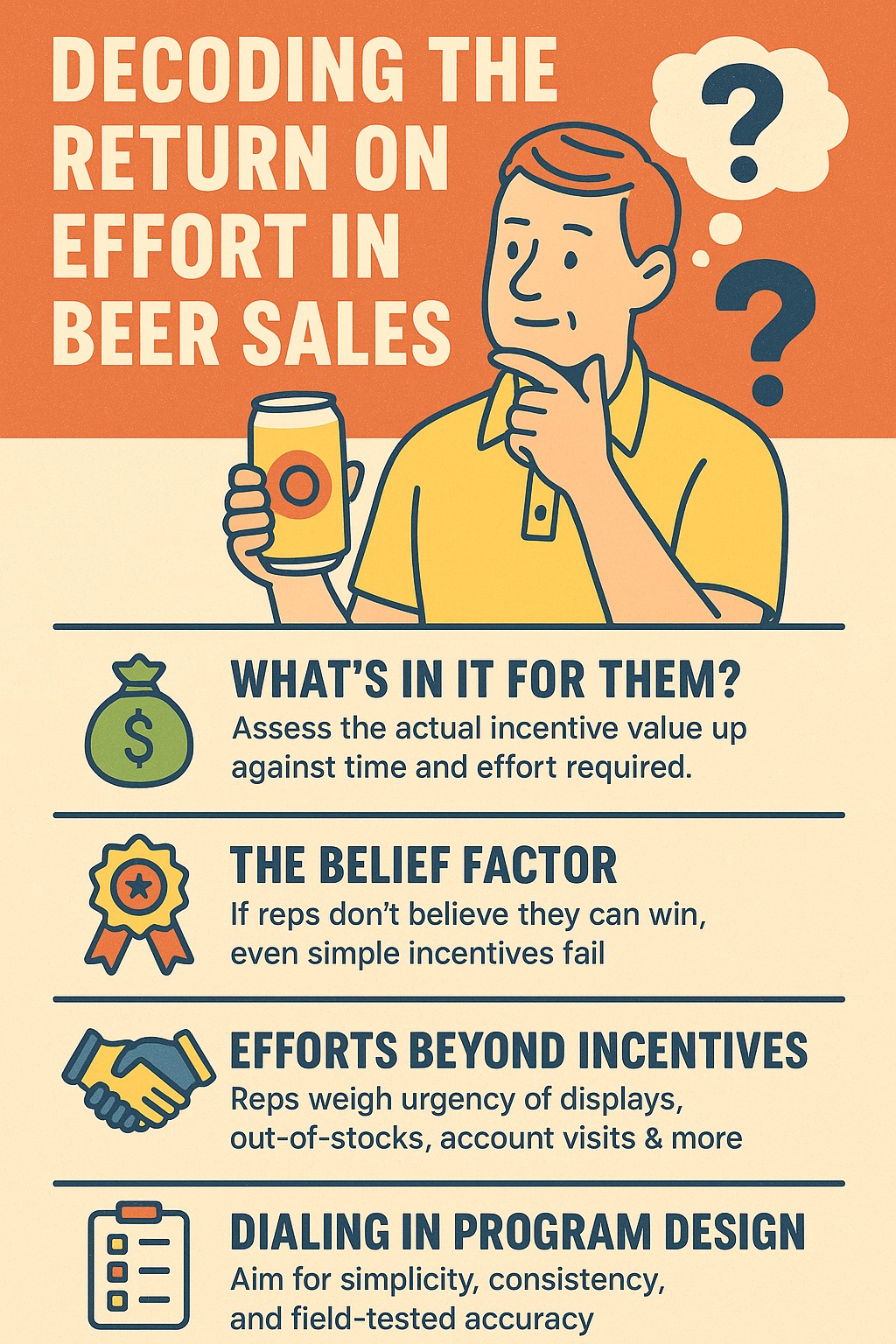
ROE vs ROI: The Human Element
While ROI (Return on Investment) focuses on hard financial returns, ROE blends tangible and intangible variables: time, energy, belief in the product and even the emotional toll of calling on tough accounts.
A manager might see a $10 incentive for a new placement and think it’s a fair offer. But if the rep sees that it requires skipping lunch, waiting 30 minutes for a buyer who’s always late, and risking a strained relationship with a long-term account, that $10 isn’t worth the cost.
ROE is behavioral economics at work. It’s the internal supply-and-demand curve of effort versus perceived value. And every rep has their own curve.
The Cost of Complexity
One common ROE killer? Overcomplicated incentive structures.
If your incentive takes a full page to explain, you’ve probably lost the room. In experiments across markets, we’ve seen that a simple 3-step, $80 incentive often outperforms an 8-step, $150 one. Reps aren’t calculating payouts to the penny — they’re doing a mental shorthand. “Do I get it? Does it seem fair? Can I pull it off without dropping balls elsewhere?”
Confusing incentives reduce perceived ROE. And once a rep opts out, no dollar value can pull them back in.
Scaling ROE Up the Ladder
ROE isn’t just a field-level concern. Team leads, ASMs and managers face the same tradeoffs.
I remember when we had a Lead Night Loader position open at my distributor. Nobody wanted it. Why? Because the pay bump was 25 cents an hour. Not enough to deal with end-of-night stress and team drama. The ROE didn’t pencil out — even at a supervisory level.
We adjusted the pay to reflect the true effort required and suddenly had multiple qualified candidates who were interested. That’s ROE math in action, just on a different rung of the ladder.
Aligning Effort with Business Goals
Here’s where the lesson becomes operational. When incentives align with company strategy — like pushing high-margin items or increasing gross profit dollars — ROE improves if reps understand the why and see the connection to their own paycheck.
This can involve tying incentives to financial outcomes like gross profit, not just volume. It’s a cleaner calculation for reps and more aligned with the business’s profitability goals. But it only works if:
- Reps understand what they’re being asked to do,
- Believe it’s achievable,
- And trust that the payout is worth it.
Otherwise, incentives become just another flyer in the truck cab.
Coaching Through the ROE Lens
Team leads and ASMs play a critical role in shaping ROE. They help reps understand:
- What incentives are worth their time,
- Where to invest extra TLC,
- And when to walk away from low-return activities.
They also make their own ROE decisions — choosing which reps to coach up, which accounts to visit, and where their time makes the biggest difference. And that decision is based on effort, outcomes, and opportunity cost — just like their team.
A Simple ROE Gut Check
If you’re wondering whether your current objectives or programs pass the ROE test, try this:
- Ask your reps: “Tell me why you chose to go after certain incentives and ignore others.”
- Watch what they don’t say: Silence is often a sign of poor ROE.
- Keep it simple: If your incentive requires a decoder ring, start over.
- Test and iterate: Small A/B tests can show which combinations of effort and payout actually move the needle.
- Vertically align: From ownership to merchandiser, everyone should be focused on profitability. ROE improves when everyone knows the mission—and sees their part in it.
Final Thought
You can’t download a report that tells you your ROE. But you can feel it. Your reps feel it every time they choose to lean in — or check out. And in a world with endless SKUs, limited time, and rising costs, effort is one of the most valuable resources you have.
Make sure you’re getting a return on it.
About the Author
If you’re looking to go deeper into how reps, team leads, and managers actually calculate what’s worth it in their daily decision-making, check out Tapped In Sales Episode 61: “Is It Worth It?” Decoding the Return on Effort in Beer Sales.
In this episode, Bud, Mikey, and Ross break down how reps silently assess whether an incentive, display, or account visit is worth their time—and why so many programs fail.
Bud Dunn is the President of Volume X Profit Tech (VXP). He is passionate about the intersection of data, strategy, and human motivation. With a focus on creating driven sales teams, Bud brings decades of experience in the beverage industry, starting with his family-owned wholesaler, Atlas Sales in Battle Creek, MI. At VXP, he works closely with beer distributors to design smarter sales incentives, reduce inefficiencies, and unlock highly profitable growth. Bud is a seasoned speaker at global and national industry events, including NBWA, the Next Generation Conference, Beer Business Daily Summit, and supplier summits around the world.
📩 Contact: bud@vxptech.com

About VXP (Volume x Profit Technologies)
Volume x Profit Technologies (VXP) helps beer distributors drive performance through smarter sales strategy, better data visibility, and accountability systems that actually stick. From incentive programs to finished product loss tracking, VXP partners with wholesalers to turn operational friction into profitable results. Whether you’re building your first scorecard or refining your sales planning, VXP brings tools and perspective that make sales teams more focused—and more profitable.
🌐 vxptech.com | 📩 info@vxptech.com