

Blog
Are You Spinning Your Wheels? Diagnosing Decline Before It’s Too Late
NBWA Associate Member VXP discusses in their Associate Member Viewpoint how to identify drivers of organizational stagnancy or decline.
By Bud Dunn, President, Volume X Profit Technologies (VXP)
When businesses plateau — or worse, decline — it’s tempting to blame the market. But more often than not, the real issue is internal. Cultural complacency, resistance to change and the dangerous assumption that “we’ve always been fine” are what quietly erode high-performing teams. And in a consolidating beer distribution landscape, inaction isn’t neutral — it’s a liability.
In a recent episode of the Tapped In Podcast, we sat down with Dr. Diane Keil-Hipp, COO of Knight Insurance and creator of the Spinning Wheels Model, to explore why organizations stall, what early warning signs to watch for, and how leaders can navigate change in even the most entrenched environments.
Why Businesses Stall (and It’s Not the Market)
Dr. Keil-Hipp’s research focuses on organizational decline and its root causes. Through her doctoral work and decades in small business leadership, she developed the Spinning Wheels Model — a diagnostic tool that helps companies identify when they’re busy but not progressing. In her words, “It’s the sense that we’re working hard, but not getting anywhere.”
The model pinpoints three interconnected drivers of decline:
- Resistance to Change — When employees or leaders avoid new approaches, processes or ideas, often due to fear, uncertainty or lack of clarity about the benefits.
- Dysfunctional Culture — A work environment where poor communication, lack of accountability or siloed thinking prevents progress and creates internal friction.
- Assumed Continuity — The belief that because the business has always succeeded, it always will — leading to complacency and missed warning signs.
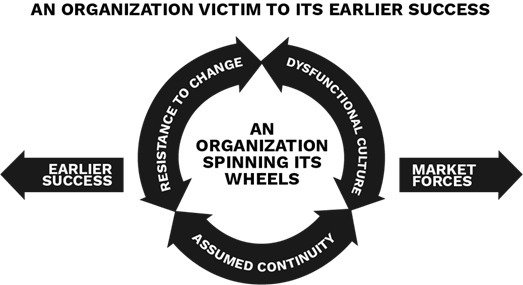
When these forces swirl together, organizations begin spinning their wheels — losing traction while market forces move on without them.
A Familiar Warning Sign: Country-Club Leadership
This dynamic often plays out in what we dubbed “country-club leadership.” These are family-run businesses operating for comfort and continuity over performance and adaptation. In this model, loyalty and tenure sometimes outweigh performance or innovation.
From my own experience turning around a legacy distributorship, I’ve seen firsthand how damaging this mindset can be. When the market got tougher, the habits and structures that once worked became liabilities. We had to shift from lifestyle leadership to financial discipline — and that meant facing hard truths and leading significant change.
The Psychology of Change Resistance
One of the most valuable insights Dr. Keil-Hipp shared was the emotional root of resistance. It’s not just about procedures or training—it’s about fear: fear of being inadequate, of losing control, of the unknown. Leaders must recognize that resistance often comes from perceived threats to identity or competence — not laziness or defiance.
To combat this, Dr. Keil-Hipp recommends involving employees early in the process. One of her guiding principles is: “Most people don’t resist change. They resist being changed.” When teams help shape the solution, buy-in skyrockets.
Practical Tools for Distributors
If you’re a beer or beverage distributor facing margin pressure, labor challenges or generational transition, here are three practical actions you can take right now:
1. Use the Organizational Traction Survey
Dr. Keil-Hipp’s free survey helps assess where your business sits on the “traction spectrum” — from spinning wheels to second gear to full traction. It takes just 10 minutes and provides an eye-opening score. Better yet, it reveals disconnects between frontline teams and leadership.
2. Map Problems to Root Causes
Dr. Keil-Hipp suggests visualizing operational issues like branches on a tree — many may stem from the same trunk. For example, a dysfunctional culture and change resistance might both trace back to one key leader or outdated process.
3. Reevaluate Senior Leadership
Teams often inherit structure that no longer serves the business. Ask yourself: Is this the team that will take us forward? If not, it may be time for tough conversations or “honorable off-ramps” — helping legacy team members exit gracefully while making space for future-focused talent.
How to Lead Change Without Breaking Culture
Driving change in long-standing organizations requires nuance. Here are four ways to bring others along:
- Appeal to loyalty: Ask tenured employees to help lead the next chapter.
- Put the ball in their court: Challenge your team to solve the problem instead of handing down a fix.
- Create healthy competition: Whether it’s a market rival or an internal benchmark, competition can spark energy.
- Set stretch goals: Metrics-focused goals with clear stakes can rally teams around shared objectives.
Importantly, once you start collecting feedback — via surveys or listening sessions — you must act on it. As Dr. Keil-Hipp warns, “There is nothing worse than surveying your team and doing nothing with the results. It’s an insult.”
Don’t Wait for Decline to Force Action
It can be easy to ignore the signs of danger. But as we discussed on the podcast, “eventually, someone else will come along who can run your business more efficiently than you can.” The question is whether you’ll take steps before or after that happens.
The good news? Change is possible — even in entrenched cultures. With the right tools, mindset, and leadership, any distributor can move from spinning their wheels to gaining traction.
Want to Learn More?
For a deeper dive into this topic, listen to Episode 82 of the Tapped In Sales podcast: “Stop Spinning Your Wheels: Diagnosing Decline Before It’s Too Late.” We explore the psychology of change resistance, what “country-club leadership” costs, and practical tools to help your team regain traction before it’s too late.
Bud Dunn is the President of Volume X Profit Tech (VXP). He is passionate about the intersection of data, strategy, and human motivation. With a focus on creating driven sales teams, Bud brings decades of experience in the beverage industry, starting with his family-owned wholesaler, Atlas Sales in Battle Creek, MI. At VXP, he works closely with beer distributors to design smarter sales incentives, reduce inefficiencies, and unlock highly profitable growth. Bud is a seasoned speaker at global and national industry events, including NBWA, the Next Generation Conference, Beer Business Daily Summit, and supplier summits around the world.

📩 Contact: bud@vxptech.com